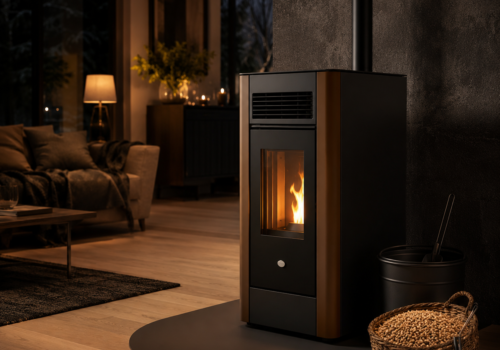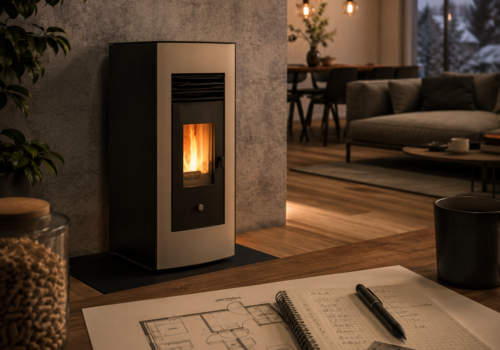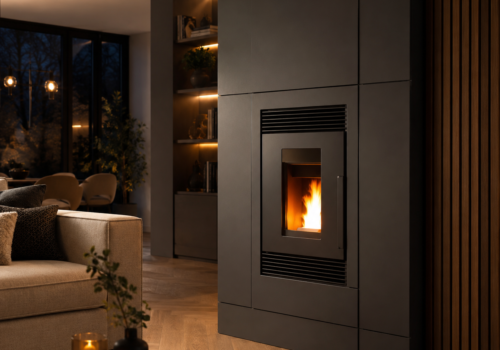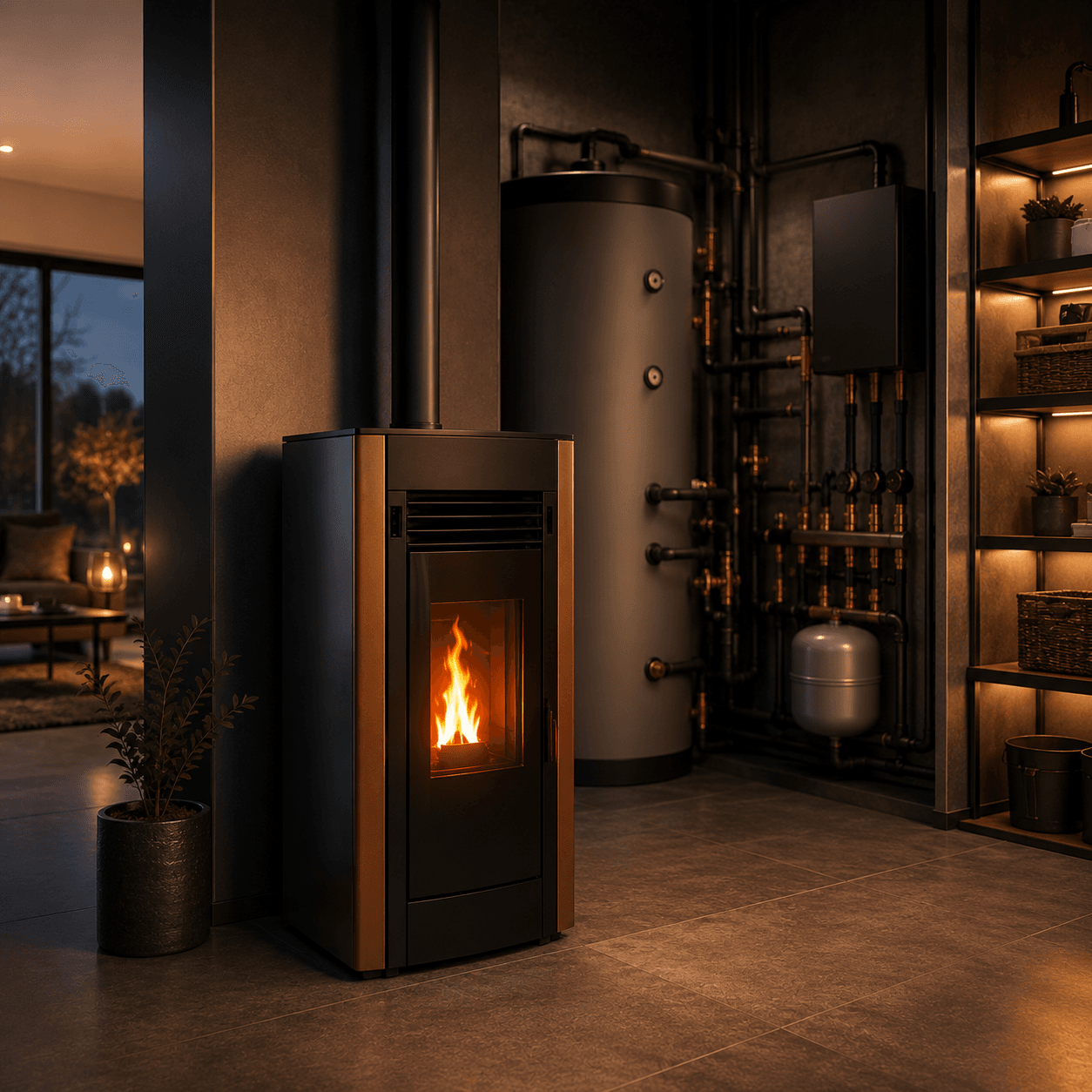
A pellet stove connected to the central heating system, also known as a ‘idro’ heater, as well as heating the room it’s in, it also heats your radiators and, sometimes, your domestic hot water. The unit costs between 3,500 and 7,000 euros, and on top of that you’ll need a buffer tank and a hydraulic connection. With fewer than six radiators, it’s rarely worth it.
A pellet stove connected to the central heating system or a pellet boiler: what’s the difference?
| Central heating pellet stove (idro) | Pellet boiler | |
|---|---|---|
| Appears in | The living area, with an open fire | Utility room, garage or cellar |
| Heats | The room and the radiators | Just the radiators |
| Power | 14 to 30 kW | 15 to 40 kW and above |
| Price of the device | 3,500 to 7,000 euros | 6,000 to 15,000 euros |
| Pellet stock | Internal tank, to be filled daily to weekly | External silo possible, several weeks’ autonomy |
| Atmosphere | Visible fire in the living room | None |
| Suitable for | Central heating for an average home | A full replacement for a gas or oil-fired boiler |
Take a look at both at pellet boilers and central heating stoves.
What is the total cost?
| Post | Central heating pellet stove | Pellet boiler |
|---|---|---|
| Device | 3,500 to 7,000 euros | 6,000 to 15,000 euros |
| Buffer tank | 700 to 1,800 euros | 800 to 2,500 euros |
| Hydraulic connection and pump unit | 800 to 2,000 euros | 1,000 to 2,500 euros |
| Flue | 800 to 2,000 euros | 800 to 2,000 euros |
| Installation and commissioning | 500 to 1,200 euros | 1,000 to 3,000 euros |
| Any pellet silo | not applicable | 1,500 to 4,000 euros |
| Realistic total | 6,300 to 14,000 euros | 11,100 to 29,000 euros |
Prices are indicative and were checked in August 2026. Always ask for a quote for the whole project, as the plumbing work varies considerably from one property to another.
Why you almost always need a buffer tank
This is the item people most often want to cut out to save money, and that’s almost always a mistake.
A pellet boiler or hydro stove works best at a constant, high output. Your radiators do not require this: on a mild day, they only need a fraction of that output. Without a buffer tank, the boiler then has to switch on and off constantly, with the same consequences as with an oversized room heater: incomplete combustion, more ash and more wear and tear.
A buffer tank stores this heat. The boiler runs at full power, charges the buffer tank and then switches off. The buffer tank then gradually releases the heat to your radiators. Advantages:
- Fewer start-stop cycles, meaning less wear and tear and less shaft
- Higher actual return
- The boiler runs for a shorter time but is cleaner
- Option to connect a solar water heater or heat pump to the same buffer tank at a later date
Rule of thumb for sizing: approximately 30 to 50 litres of buffer per kW of the appliance’s output. A 20 kW stove therefore requires roughly 600 to 1,000 litres.
Combining with an existing gas boiler
That’s possible, and it’s a common arrangement in renovation projects. The pellet stove does most of the work; the gas boiler kicks in on the coldest days or to provide hot water for domestic use in the summer.
In practical terms, this works via a buffer tank to which both appliances are connected, with a control system that determines which one takes priority. Advantage: you have a backup, and you don’t need to size the pellet stove for the coldest possible day. Disadvantage: you still have to pay the standing charges for your gas connection.
When is it worth it, and when isn’t it?
| Situation | Verdict |
|---|---|
| An older house, ten or more radiators, standard supply temperatures | A strong contender, but the heat pump performs poorly here |
| Replacement of a heavy fuel oil boiler | Strong candidate, similar reasoning and storage requirements |
| A house with underfloor heating and good insulation | A heat pump is usually a better and cheaper option |
| A small flat with four to six radiators | Overkill, choose a flue-connected room heater |
| No space for a buffer tank | A major objection: a buffer is almost always necessary |
| No dry storage for pellets | If you’re concerned about your consumption, expect to use 3 to 5 tonnes a year |
How many pellets does a system like this use?
Considerably more than a room heater. For a whole house, allow for 2,500 to 4,000 kg per heating season – that is, three to four full pallets. In the case of a large, poorly insulated house, this can rise to 5 tonnes.
This makes storage a key consideration when planning: four pallets take up around four square metres, or you could opt for a silo with an automatic feed system. Take a look at our pellets in terms of the price per pallet, as the purchase price accounts for a significant proportion of the cost at this level of consumption.
Maintenance is more intensive
A appliance that runs day and night requires more than a stove that is lit in the evening:
- Empty the ash pan: weekly or more frequently, depending on usage
- Burner pot: weekly
- Heat exchanger: monthly; some units do this automatically
- Annual servicing by a qualified technician: compulsory, and more extensive for a central heating system than for a room heater
- Chimney sweeping: annually
At this rate of consumption, it is particularly worthwhile to opt for pellets with a low ash content. The difference between 0.7 and 0.4 per cent ash amounts to just over twelve kilograms of ash per season when using four tonnes.
For maintenance and the annual inspection, please contact Pellet Stove Care.
Frequently Asked Questions
Can a pellet stove be connected to the central heating system?
Yes, with a central heating version, also known as a hydronic heater. It has a built-in heat exchanger that heats water for your radiators. A standard air heater cannot do that.
How much does a pellet stove with a central heating connection cost?
The unit costs between 3,500 and 7,000 euros. Including the buffer tank, hydraulic connection, flue and installation, the total cost for the complete installation is realistically between 6,300 and 14,000 euros.
Do I need a buffer tank?
In virtually all cases, yes. Without a buffer, the appliance switches on and off constantly, leading to incomplete combustion, more ash and faster wear and tear. Allow for 30 to 50 litres per kW of output.
Can a pellet stove also provide domestic hot water?
Some central heating systems do, usually via a boiler or a buffer tank with a built-in heat exchanger. In summer, this is not very efficient, as the boiler has to run just to provide hot water. Many people therefore combine this with a solar water heater or an electric boiler.
What is the difference between a pellet stove and a pellet boiler?
A central heating pellet stove is installed in the living area with a visible fire and heats the room as well as the radiators. A pellet boiler is installed in a utility room; it has no decorative function and is a fully-fledged replacement for a gas or oil-fired boiler, offering higher output and greater storage capacity.
How many pellets does a central heating pellet stove use?
For a typical home, 2,500 to 4,000 kg per heating season, which is three to four pallets. For a large or poorly insulated home, this can rise to five tonnes.
{“@context”:”https://schema.org”,”@type”:”FAQPage”,”mainEntity”:[{“@type”:”Question”,”name”:”Can a pellet stove be connected to a central heating system?”,”acceptedAnswer”:{“@type”:”Answer”,”text”:”Yes, with a central heating model, also known as a hydro stove. This has a built-in heat exchanger that heats water for your radiators. A standard air-heating stove cannot do this.”}},{“@type”:”Question”,”name”:”How much does a pellet stove with a central heating connection cost?”,”acceptedAnswer”:{“@type”:”Answer”,”text”:”The unit itself costs between 3,500 and 7,000 euros. Including a buffer tank, hydraulic connection, flue and installation, a realistic total for the full installation is between 6,300 and 14,000 euros.”}},{“@type”:”Question”,”name”:”Do I need a buffer tank?”,”acceptedAnswer”:{“@type”:”Answer”,”text”:”In almost all cases, yes. Without a buffer tank, the stove will constantly switch on and off, leading to incomplete combustion, more ash and faster wear and tear. Allow for 30 to 50 litres per kW of output.”}},{“@type”:”Question”,”name”:”Can a pellet stove also provide domestic hot water?”,”acceptedAnswer”:{“@type”:”Answer”,”text”:”Some central heating models can, usually via a hot-water cylinder or a buffer tank with a built-in heat exchanger. In summer, this is not very efficient, as the stove has to run solely to provide hot water. Many people therefore combine it with a solar water heater or an electric boiler.”}},{“@type”:”Question”,”name”:”What is the difference between a pellet stove and a pellet boiler?”,”acceptedAnswer”:{“@type”:”Answer”,”text”:”A central heating pellet stove is situated in the living area with a visible flame and heats the room as well as the radiators. A pellet boiler is installed in a utility room, has no decorative function and is a fully-fledged replacement for a gas or oil-fired boiler, offering higher output and greater storage capacity.”}},{“@type”:”Question”,”name”:”How many pellets does a central heating pellet stove use?”,”acceptedAnswer”:{“@type”:”Answer”,”text”:”For an entire house, 2,500 to 4,000 kg per heating season, i.e. three to four pallets. For a large or poorly insulated home, this can rise to five tonnes.”}}]}