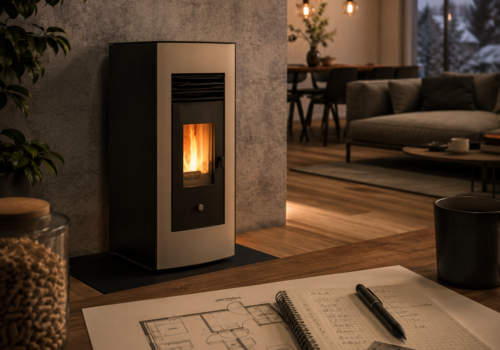
In 2026, a built-in pellet stove will cost between 2,000 and 5,000 euros for the unit alone, plus 800 to 2,500 euros for the flue and installation. The main difference compared with a freestanding model lies not in the price but in the installation requirements: you need a recess of the correct dimensions, a fresh air supply and an accessible pellet hopper.
What is a built-in pellet stove?
A built-in fire, also known as a cassette or built-in fireplace, is installed in a recess or within an existing fireplace opening. Only the front panel with the glass remains visible. This creates a sleek, integrated fire view without the appliance taking up space in the room.
Technically speaking, a built-in pellet stove is the same appliance as a freestanding one pellet stove: screw conveyor, burner pot, fan, heat exchanger. The difference lies in the housing and in how you operate and maintain it.
Prices by asset size
| Power | Indicative price of the device | Suitable for |
|---|---|---|
| 6 to 7 kW | 2,000 to 2,800 euros | Space of up to approximately 35 m² |
| 8 to 9 kW | 2,400 to 3,400 euros | Space of up to approximately 45 m² |
| 10 to 12 kW | 3,000 to 4,200 euros | Large living space or suitable for conversion |
| CV version (idro) | 3,500 to 5,000 euros | Connection to radiators |
Prices are indicative and were checked in August 2026. View the current range at our built-in pellet stoves.

What else is included in the price of the device?
| Post | Indications | When |
|---|---|---|
| Flue or lining | 600 to 2,000 euros | Almost always |
| Installation and connection | 300 to 800 euros | Always |
| Creating or modifying a niche | 300 to 1,500 euros | For new builds or renovations |
| External air supply | 150 to 400 euros | In airtight homes |
| Finishing touches around the stove | variable | When creating a new recess |

Built-in versus freestanding: a fair comparison
| Built-in | Freestanding | |
|---|---|---|
| Appearance | Sleek, built-in, no appliance in the room | A visible device – more atmosphere for some |
| Unit price | Higher | Bearing |
| Installation cost | Higher, especially if a recess is to be included | Bearing |
| Space requirements | No floor space | Takes up floor space |
| Topping up the pellets | Via the front drawer or top drawer; less spacious | Spacious top-mounted tank |
| Maintenance | Less accessible; see below | Easily accessible |
| Heat output | Mainly forwards via the fan | Radiation from all sides as well |
| Portable | No | In principle, yes |

Can you convert a fireplace?
This is often the case, and it is one of the most common reasons for choosing a built-in model. Conditions:
- The opening must be large enough. Measure the width, height and, above all, the depth. Depth is the dimension that most often causes problems.
- The flue must be suitable. An old open-fire chimney is usually too wide for a pellet stove and must be lined with a flexible or rigid flue pipe of the correct diameter.
- An electricity connection is required. Often overlooked in the planning stage.
- The chimney must be sealed. If you have an old, draughty chimney, it needs to be renovated first.
A chimney scan using a camera provides a definitive assessment of the condition and clearance of the flue in advance. It’s best to have this carried out before you order a boiler, as the results may influence your choice. Pellet Stove Care carries out that sort of measurement and installation work.
Where do you top up the pellets?
With a freestanding appliance, you simply pour the contents of the bag into the top of the tank. With a built-in appliance, there are three ways to do this:
| System | How it works | Point to note |
|---|---|---|
| Front-loading | Pull-out drawer at the front, underneath or next to the glass | Most practical, but with a smaller capacity |
| Top drawer | Flap at the top of the recess | Requires clearance above the unit |
| External tank with screw pump | Separate storage bin, automatic feed | More expensive, but you don’t need to top up nearly as often |
Always ask for the tank capacity in kilograms. With built-in appliances, this is often lower than with freestanding models, so you’ll need to top it up more often.
The accessibility trap in maintenance
This is the point that online shops rarely mention and that you only realise after a year.
A built-in pellet stove It requires the burner pot to be emptied weekly and the heat exchanger to be brushed clean from time to time. With a freestanding appliance, this takes just five minutes. With a built-in appliance that is too deep or too tightly fitted into the recess, or where the finish extends over the service panels, it becomes quite a job.
What you need to sort out in advance:
- Have the stove installed on runners so that it can be pushed forwards for servicing. Most manufacturers provide this.
- Do not close off the recess right up to the appliance. Provide removable panels; do not use a fixed brickwork finish.
- Ensure that the flue gas fan is accessible, usually at the back or at the bottom. That is the part that is replaced after eight to twelve years.
- Fit an inspection hatch in the flue, otherwise it is not possible to sweep the stove without dismantling it.
Discuss this with your fitter before the recess is built, not afterwards. Breaking open a finished surface afterwards costs more than doing it properly from the start.
What sizes do you need?
To get a quote or to compare prices yourself, measure:
- Width, height and depth of the recess or fireplace opening, at its narrowest point
- Diameter and position of the existing flue
- Height of the chimney above the roof
- Distance to the nearest power socket
- Free space above and to the side of the recess for air supply and topping up
Take a photo of the current situation as well. This will help when deciding whether the conversion is feasible.
Disadvantages of a built-in pellet stove
To be honest, there are three:
- It’s more expensive, both the device and its installation.
- Maintenance is less accessible, especially if the recess has a sleek finish.
- It emits less radiant heat. A freestanding heater radiates heat from all sides; a built-in heater mainly directs its heat forwards via the fan. In a large room, this feels less enveloping.
On the other hand, you don’t lose any floor space and the fire looks neater. Moreover, for those with an existing open fire, it is often the only way to put it to good use.
View the range built-in pellet stoves or compare it with the full range of pellet stoves. For the fuel itself, see pellets.
Frequently Asked Questions
How much does a built-in pellet stove cost?
The appliance costs between 2,000 and 5,000 euros, depending on its output and model. On top of that, you’ll need to add between 800 and 2,500 euros for the flue and installation, and more if a recess needs to be built.
Can I replace my open fireplace with a built-in pellet stove?
Usually, yes, provided the opening is deep enough and the flue can be fitted with the correct diameter. A chimney scan using a camera will confirm this in advance. Don’t forget the electricity connection, which is not provided with an open fire.
What are the disadvantages of a built-in pellet stove?
It is more expensive than a freestanding model; maintenance is more difficult if the recess is neatly finished; and it gives off less radiant heat because most of the heat is directed forwards via the fan.
How often do I need to top up the pellets in a built-in stove?
That depends on the tank capacity, which is often smaller in built-in appliances than in freestanding models. Allow for one to two days’ use if used daily. Always ask for the tank capacity in kilograms.
Do I need a flue for a built-in pellet stove?
You will need a suitable flue. This could be an existing chimney that is lined, or a new double-walled flue. An existing open-fire chimney is almost always too wide and must be fitted with a liner of the correct diameter.
How big should the recess be?
This varies from appliance to appliance. Always measure at the narrowest point and take into account the clearance specified by the manufacturer around the appliance for ventilation. Obtain the installation diagram before having the recess made.