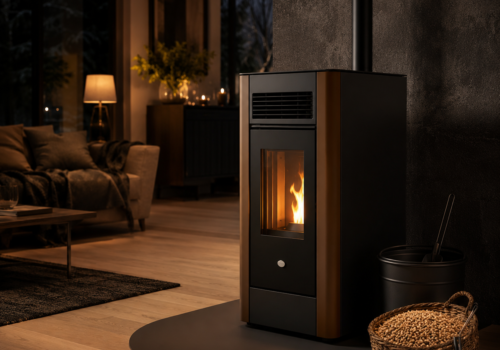
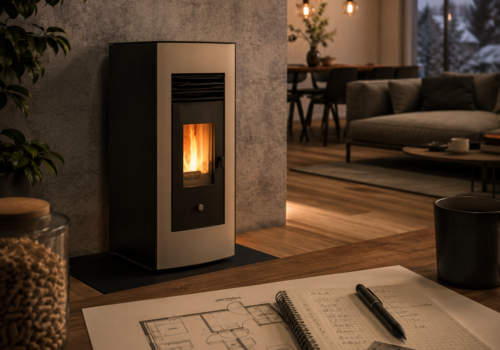
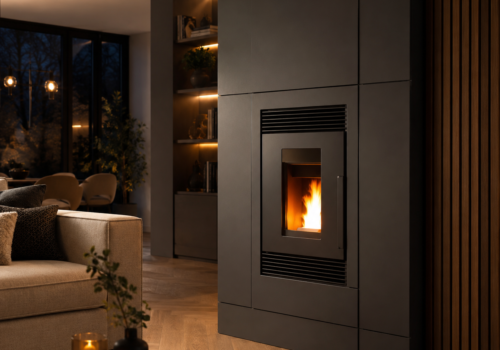
For a space of up to approximately 30 square metres a small pellet stove, 4 to 6 kW. However, the minimum power output is more important than the maximum: a small room requires a unit that can operate at 2 to 3 kW without constantly switching on and off.
Anyone looking for a small pellet stove is usually after one of three things: a stove with low heat output, a stove that takes up little space, or both. These are not the same characteristics, and the distinction determines which model you need.
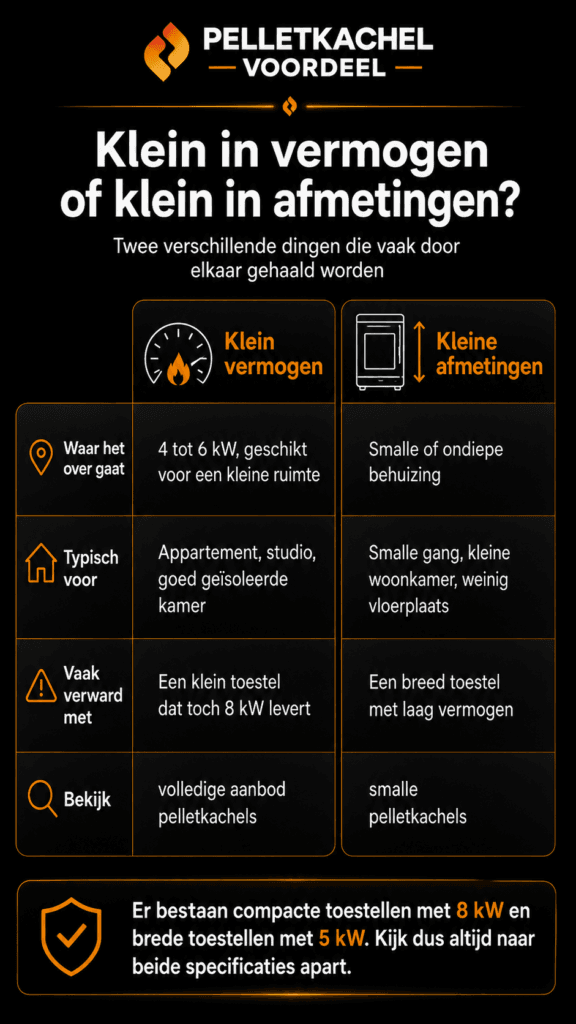
Low power or small in size?
| Small capital | Compact dimensions | |
|---|---|---|
| What it’s all about | 4 to 6 kW, suitable for a small room | Narrow or shallow housing |
| Typical of | Flat, studio, well-insulated room | Narrow corridor, small living room, limited floor space |
| Often confused with | A small unit that still delivers 8 kW | A wide-body aircraft with low power output |
| View | full range of pellet stoves | narrow pellet stoves |
There are compact units with a power rating of 8 kW and wider units with a power rating of 5 kW. So always check both specifications separately.
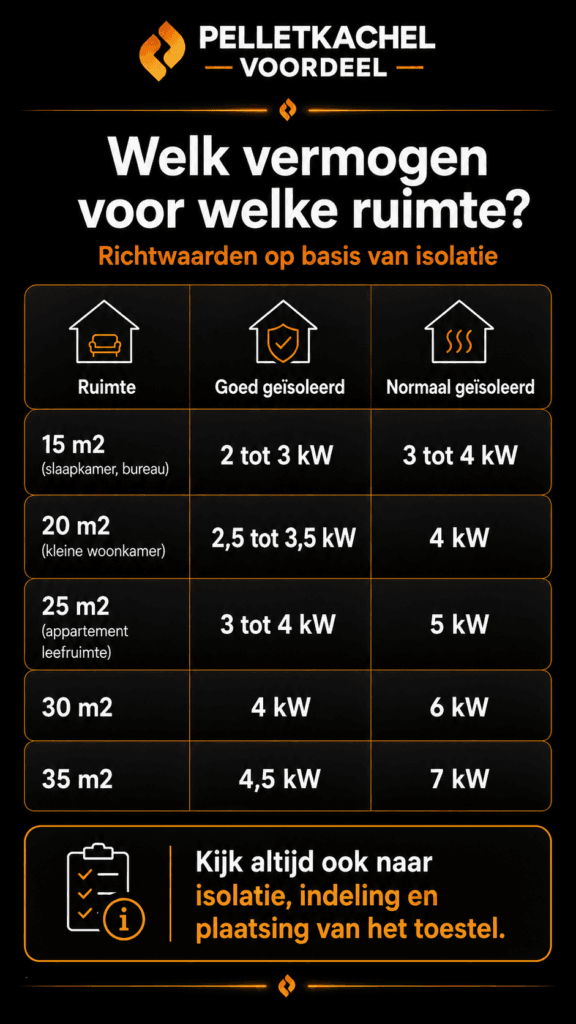
What power rating for which room?
| Space | Well insulated | Normally insulated |
|---|---|---|
| 15 m² (bedroom, study) | 2 to 3 kW | 3 to 4 kW |
| 20 m² (small living room) | 2.5 to 3.5 kW | 4 kW |
| 25 m² (apartment living space) | 3 to 4 kW | 5 kW |
| 30 m² | 4 kW | 6 kW |
| 35 m² | 4.5 kW | 7 kW |
The minimum power is more important here than the maximum
This is the crux of the problem with small spaces, and it is hardly ever explained.
A pellet stove varies between a minimum and a maximum. A unit that, on paper, delivers 6 kW often has a minimum output of 3 kW. In a room that only requires 3 kW, that’s just about right. But an 8 kW unit with a minimum output of 4.5 kW will constantly be running too hard in that same room.
What happens then is this: the stove quickly reaches the set temperature, switches off, cools down, and restarts twenty minutes later. Each start-up requires an ignition cycle, using extra pellets and extra electricity, and combustion is incomplete every time the stove starts up. This means you end up with more ash, soot on the window and higher fuel consumption than the specifications suggest.
Rule of thumb: For a small room, look for a unit whose minimum output does not exceed half of your calculated requirement.
Other things to bear in mind
Fuel tank capacity versus fuel consumption
Smaller appliances often have a smaller tank, sometimes 10 to 12 kg instead of 20 to 30. You also use less at a low setting, so in practice they last just as long. Do the maths: tank capacity divided by hourly consumption gives you the running time.
Sound carries further in a small space
In a 20-square-metre living room, you’ll be sitting closer to the unit than in a 60-square-metre room. As a result, the noise from the fan and compressor is more noticeable. Ask about the specified noise level in decibels and, if in doubt, choose a unit with a larger heat exchanger, as this will run more quietly at the same power output.
Clearance from walls and furniture
Every manufacturer specifies minimum clearances from flammable materials, usually 10 to 20 cm at the sides and 20 to 50 cm at the back. In a small room, this could be the deciding factor. Make sure you check these clearances before you order.
Flue and air intake
Even a small stove has a fully-fledged flue required. Furthermore, in small, well-insulated rooms, an external air supply is often mandatory or strongly recommended, as otherwise the appliance will draw oxygen from the living space.
In what situations are small appliances intended for use?
| Situation | Advice |
|---|---|
| Flat, living space up to 30 m² | 4 to 5 kW; please ensure there is an external air supply |
| Studio flat or small flat | 3 to 4 kW with a low minimum power rating |
| Additional heating in a well-insulated room | 2.5 to 4 kW |
| Narrow space, corridor or corner | Take a look at narrow pellet stoves, not merely according to one’s means |
| Holiday home or chalet | 4 to 6 kW – choose a heater that heats up quickly |
| Veranda | Allow for a higher figure due to the glazing; this is often 6 to 8 kW |
A common mistake: buying something too big “just to be on the safe side”
When in doubt, many people opt for the more powerful model, as that way you’re sure to be fine even on the coldest day. In practice, however, this backfires.
During that one coldest week of the year, with a heater that’s just a bit too small, you might only reach 19 degrees instead of 21. For the remaining twenty weeks, that same heater runs cleanly and efficiently. An oversized heater does the opposite: it performs perfectly during that one week, but poorly during the other twenty weeks.
So it’s better to choose a size on the smaller side. You can always add extra warmth on really cold days; there’s no solution for twenty weeks of poor combustion.
View narrow pellet stoves or whether it full range of pellet stoves. For installation and flue calculations, please contact Pellet Stove Care.
Frequently Asked Questions
What is the smallest pellet stove?
The smallest appliances on the market have a minimum power output of around 2 to 2.5 kW and a maximum of around 4 kW. There are also very compact models around 35 cm wide, but these do not always have the lowest power output.
What capacity pellet stove is suitable for a 30 m² room?
With standard insulation, around 6 kW; with good insulation, around 4 kW. You should also check the minimum power rating: ideally, this should not exceed 3 kW.
Can a pellet stove be too small?
Yes, but the consequences are less severe than with a stove that is too large. A stove that is too small will not reach the desired temperature on the coldest days, but will operate cleanly and efficiently for the rest of the season.
Will a pellet stove fit in a flat?
Technically, this is often possible, provided there is a suitable flue and the co-ownership regulations allow it. The main practical objection is usually the storage of pellets, not the appliance itself.
Is a small pellet stove cheaper?
Technically, this is often possible, provided there is a suitable flue and the co-ownership regulations allow it. The main practical objection is usually the storage of pellets, not the appliance itself.
How many pellets does a small pellet stove use?
At an average setting, approximately 0.5 to 0.8 kg per hour for a 4 to 6 kW appliance. A 15 kg bag will therefore last for around 20 to 30 hours.