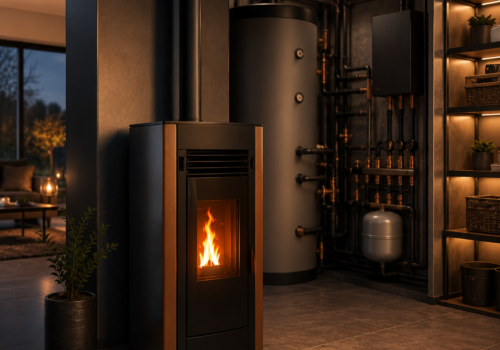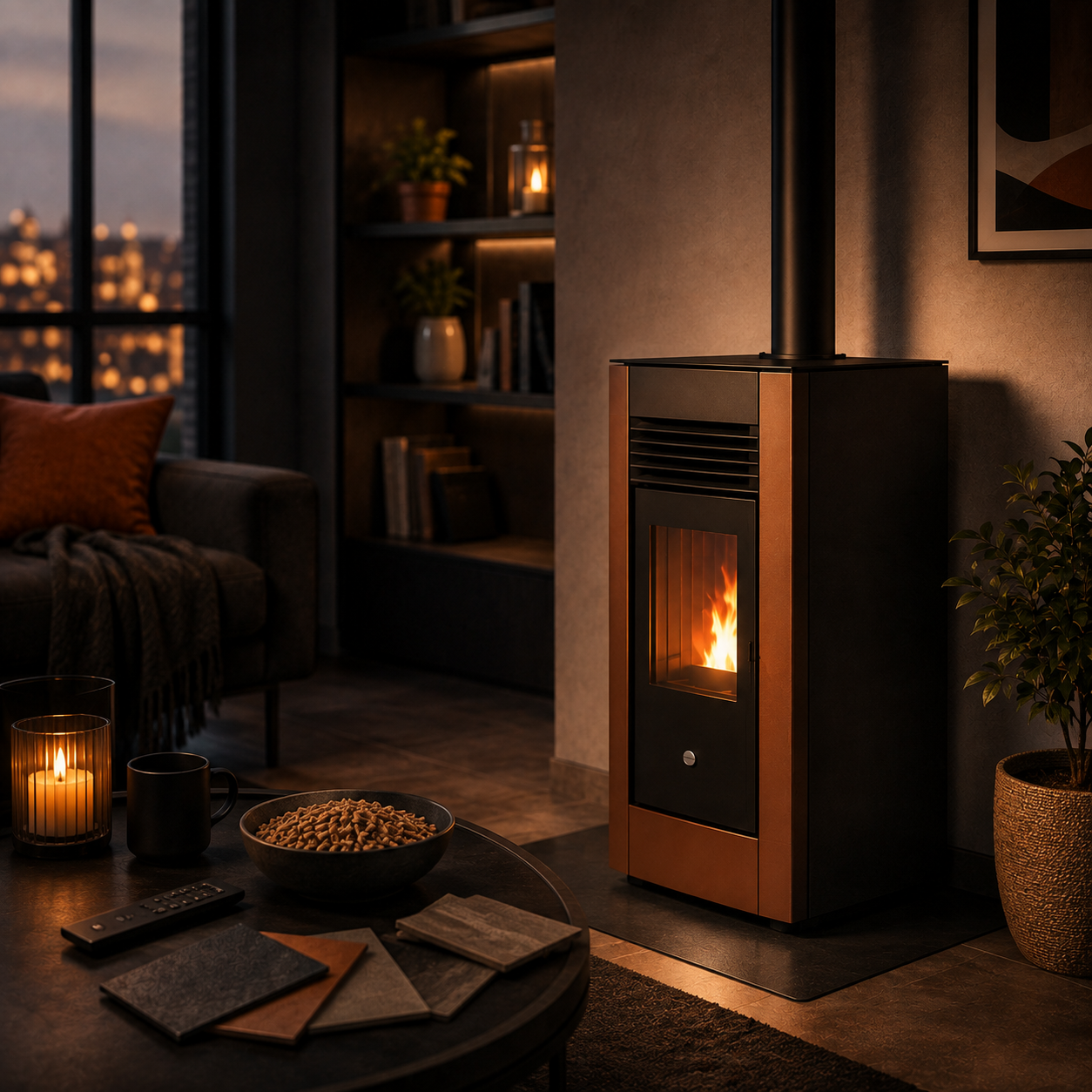
There is no such thing as the ‘best’ pellet stove in general. What does exist, however, is the the right stove for your space, and you can assess this on the basis of ten criteria: power, modulation range, noise level, tank capacity, flue connection options, air supply, dimensions, availability of spare parts, warranty and the availability of a local after-sales service.
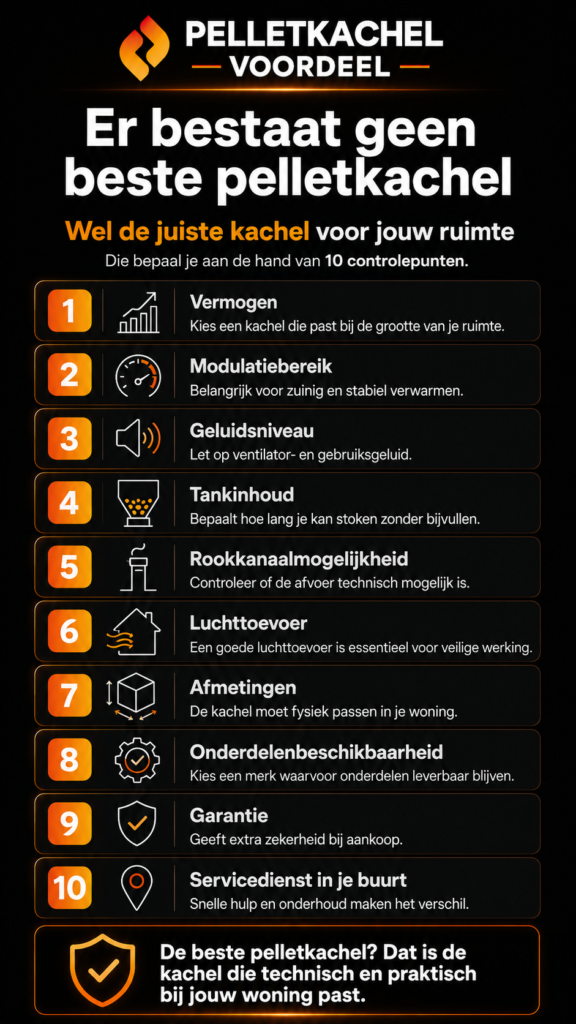
Rankings of the top ten brands don’t mean much, as most devices in the same price range use similar technology. The difference lies in whether the device is the right fit.
Choose the best pellet stove for you
1. Power: the area where things most often go wrong
Allow for approximately 0.08 kW per cubic metre with standard insulation. A living room measuring 40 square metres with a ceiling height of 2.5 metres would therefore require around 8 kW.
If in doubt, choose a bit on the small side. A stove that is too large runs constantly at minimum power, leading to incomplete combustion, soot on the glass, a lot of ash and more noise. A stove that is too small just fails to reach the desired temperature on the coldest days, but performs cleanly for the rest of the season.
2. Modulation range: also check the minimum
Everyone compares the maximum output. The minimum is just as important, because that’s the setting your stove will run on for most of the season.
Two 8 kW units can differ significantly: one varies in output from 2.4 to 8 kW, whilst the other varies from 5 to 8 kW. The first unit works well in the shoulder seasons, whilst the second switches on and off constantly during that time.
3. Noise level
Ask about the specified noise level in decibels, at both the lowest and highest settings. Below 42 dB on the low setting, it is quiet; above 50 dB on the high setting, it is noticeably audible.
Units with a larger heat exchanger and a slower fan run more quietly at the same power output than compact models, which have to expel the heat more quickly.
4. Fuel tank capacity versus fuel consumption
Divide the tank capacity by your expected hourly consumption, and you’ll know how often to top up.
| Fuel tank capacity | Consumption 0.8 kg/h | Consumption: 1.5 kg/h |
|---|---|---|
| 12 kg | 3.00 pm | 8 hours |
| 18 kg | 10 pm | 12 o'clock |
| 25 kg | 31 hours | 5.00 pm |
| 35 kg | 44 hours | 11 pm |
If you use your heating every day and don’t want to top up the fuel every day, you’ll need at least 20 kg.

5. Option for a flue
This often has a greater influence on your choice than the appliance itself. Do you have an existing flue that can be lined, or will a completely new double-walled flue need to be installed? That difference can easily amount to a thousand euros.
Make sure you sort this out before you order a unit, not afterwards. A chimney scan using a camera will give you a clear picture of its condition and whether it’s clear.
6. Air supply
A pellet stove requires combustion air. In a well-insulated or airtight home, it cannot simply draw this air from the living space without causing negative pressure, particularly when used in conjunction with a cooker hood or ventilation system.
You should therefore check whether the device is suitable for external air supply, also known as hermetic or airtight. This is often a requirement in new-build properties and following a thorough renovation.
7. Dimensions and clearances
Measure not only the appliance itself but also the required clearances from flammable materials: usually 10 to 20 cm at the sides and 20 to 50 cm at the back. Add to this the space you need to open the door and remove the ash pan.
8. Availability of parts
This point is rarely included in comparisons, yet it is the most important one over a ten-year period.
A pellet stove contains parts that are subject to wear and tear and will need replacing sooner or later: the ignition resistor after three to six years, the door seal, and the flue gas fan after eight to twelve years. If the brand is small, new or has no Belgian importer, a faulty circuit board could spell the end for the appliance.
Ask explicitly: how long Are spare parts still available? Who supplies them in Belgium? And is there a service centre in the region? A good answer to those three questions is worth more than a ten per cent discount.
9. Warranty, and what exactly it covers
Look beyond the number of years. What matters more is what the warranty covers:
- Does it apply to the whole machine or just the casing?
- Are wear parts such as the firebox and the seal excluded?
- Does the warranty become void if uncertified pellets are used? It does with many manufacturers.
- Does it lapse if there is no evidence that the annual maintenance has been carried out? This is also the case with many manufacturers.
10. Is there a service in your area?
A stove that requires annual servicing and the replacement of a part every few years is best served by a local repairer. A brand that’s cheaper online but for which no one in Limburg will come out to service it will ultimately cost you more.
The three most common mistakes
- Buy a size too big, just to be on the safe side. See point 1. This is the cause of most disappointments.
- Compare the price of the handset only. Flue and installation often costs as much as the stove itself. Compare quotes for the whole package.
- Check the flue only afterwards. Sometimes it turns out that the chosen stove does not fit the available flue.
Questions to ask the seller
- What is the minimum power, not just the maximum?
- What are the decibel levels at the lowest and highest settings?
- What is the tank capacity in kilograms?
- Is the unit suitable for an external air supply?
- How long will spare parts remain available, and who supplies them?
- How much will the installation cost, including the flue, in my case?
- What exactly does the warranty cover, and what does it exclude?
Take a look full range of pellet stoves, or compare specifically at built-in pellet stoves, narrow pellet stoves and pellet boilers and central heating stoves. For installation and maintenance, please contact Pellet Stove Care.
Frequently Asked Questions
What is the best pellet stove?
There isn’t a single model that’s best for everyone. The best unit is the one that matches your space in terms of power, has a low minimum power requirement, for which spare parts remain available, and for which servicing is available in your area.
What is a reliable brand of pellet stove?
Reliability depends less on the brand than on the combination of factors: correct sizing, annual maintenance and certified pellets. However, it is wise to choose a brand with a Belgian importer and a proven supply of spare parts.
What are the top 5 pellet stoves?
Such lists are of little use, as appliances in the same price range use similar technology. It’s better to compare them based on the ten points above, because a top-of-the-range model that doesn’t fit in your space will perform worse than a basic appliance that does.
How much does a good pellet stove cost?
The appliance costs between 1,200 and 4,500 euros, depending on its output and model. Add a further 800 to 2,500 euros for the flue and installation.
What should I look out for when buying a pellet stove?
In order of importance: the right capacity for your space, the modulation range, the flue connection option, the noise level, the tank capacity, and the availability of spare parts and after-sales service.
What is the average lifespan of a pellet stove?
With proper maintenance, fifteen to twenty years. The ignition resistor lasts three to six years, the flue gas fan eight to twelve years, and the door seal needs replacing every few years.
{“@context”:”https://schema.org”,”@type”:”FAQPage”,”mainEntity”:[{“@type”:”Question”,”name”:”What is the best pellet stove?”,”acceptedAnswer”:{“@type”:”Answer”,”text”:”There isn’t a single model that’s best for everyone. The best stove is one whose output suits your space, which has a low minimum output, for which spare parts remain available, and for which servicing is available in your region.”}},{“@type”:”Question”,”name”:”What is a reliable brand of pellet stove?”,”acceptedAnswer”:{“@type”:”Answer”,”text”:”Reliability depends less on the brand than on the combination of correct sizing, annual maintenance and certified pellets. However, it is wise to choose a brand with a Belgian importer and a proven supply of spare parts.”}},{“@type”:”Question”,”name”:”What are the top 5 pellet stoves?”,”acceptedAnswer”:{“@type”:”Answer”,”text”:”Such lists are of little use, as appliances in the same price range use similar technology. It is better to compare them based on the ten points above, as a top-of-the-range model that doesn’t suit your space will perform worse than a simpler appliance that does.”}},{“@type”:”Question”,”name”:”How much does a good pellet stove cost?”,”acceptedAnswer”:{“@type”:”Answer”,”text”:”The stove costs between 1,200 and 4,500 euros, depending on its output and model. On top of that, add 800 to 2,500 euros for the flue and installation.”}},{“@type”:”Question”,”name”:”What should I look out for when buying a pellet stove?”,”acceptedAnswer”:{“@type”:”Answer”,”text”:”In order of importance: the correct heat output for your room, the modulation range, the flue connection options, the noise level, the hopper capacity, and the availability of spare parts and after-sales service.”}},{“@type”:”Question”,”name”:”What is the average lifespan of a pellet stove?”,”acceptedAnswer”:{“@type”:”Answer”,”text”:”Fifteen to twenty years with proper maintenance. The ignition resistor lasts three to six years, the flue gas fan eight to twelve years, and the door seal needs replacing every few years.”}}]}