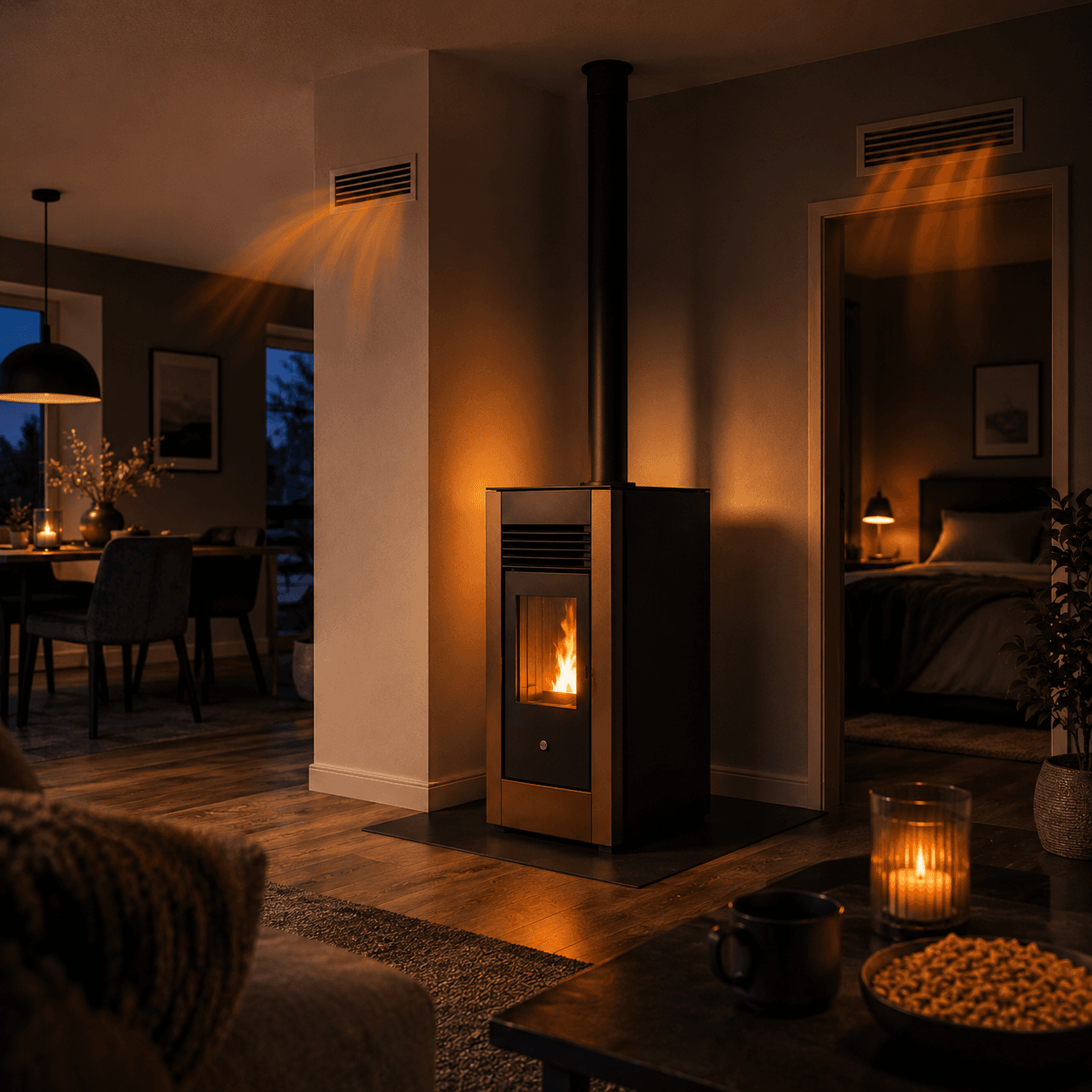
A ductable pellet stove blows part of his warm air via insulated pipes to other rooms, typically one to three additional rooms up to a distance of approximately six to eight metres. Beyond that length, the efficiency per duct drops rapidly and a central heating solution becomes a more sensible option.

How does channelling work?
A standard pellet stove blows all its warm air into the room where it is situated. A ducted stove has one or more additional outlets at the top or rear, each with its own fan. You connect a flexible or rigid pipe – usually 80 mm in diameter – to these outlets, which you then run through the wall, ceiling or crawl space to another room.
In that room, a grille will be fitted into the wall or ceiling. The heater determines how much heat is directed into each duct; with higher-quality units, this can even be controlled separately for each outlet.
How many rooms can you connect?
| Number of channels | Typical power | Practice |
|---|---|---|
| 1 channel | 8 to 10 kW | An adjoining room or the floor above |
| 2 channels | 10 to 12 kW | Two bedrooms or one room plus a hallway |
| 3 channels | 12 to 14 kW | The maximum capacity for an air system requires careful planning |
Important: the heat that is channelled into the ducts is deducted from the heat in the main living area. A 12 kW stove with two ducts does not deliver 12 kW to the living room plus an additional amount to the bedrooms. Add up the total heat requirements for all rooms.
Maximum channel length and why that limit exists
Most manufacturers specify six to eight metres per channel as the maximum. This is not a matter of caution but of physics:
- Heat loss during transport. Even through an insulated pipe, the air cools down. After eight metres, the difference compared with the boiler room is already considerable.
- Pressure loss. Every metre of pipework – and certainly every bend – reduces air pressure. The fan has to work harder for less result.
- Bends count double. A 90-degree bend is roughly equivalent to one and a half metres of straight pipe. So three bends will cost you nearly five metres of your budget.
Practical information: Keep the ducts as straight and as short as possible, insulate them along their entire length, and avoid routing them through unheated areas such as a cold loft.
Noise: the complaint you want to avoid in the first place
This is the aspect that, in hindsight, is most often a let-down, and it can almost always be avoided.
A ducted heater blows air through a pipe, and that makes a noise. There are two types:
- Airflow noise on the grille in the receiving room. The narrower the duct and the higher the fan speed, the louder it is.
- Transmission of stove noise through the duct. A rigid metal duct literally channels the noise from the fan into the bedroom.
What it solves:
- Choose a larger pipe diameter than the minimum. The same volume of air flows more slowly – and therefore more quietly – through a wider pipe.
- Use a flexible sound-absorbing component close to the heater to prevent the transmission of vibrations.
- Do not place the grille directly above a bed. It goes without saying, but it does happen.
- Choose an appliance where the duct fan can be controlled separately, so that you can switch back at night.
Make sure you ask your installer about this specifically. A duct leading to a bedroom requires a different approach to one leading to a study.
Ducting for a central heating pellet stove
| Ductable (air) | Central heating stove or pellet boiler (water) | |
|---|---|---|
| Heats | 1 to 3 extra rooms | The whole house via radiators |
| Range | 6 to 8 metres per channel | The whole property, no practical boundary |
| Unit price | 2,000 to 4,200 euros | 3,500 to 7,000 euros |
| Installation work | Pipes through walls or ceilings | Hydraulic connection plus buffer tank |
| Domestic hot water | No | May be available on certain models |
| Extent | Limited | Large |
| Reaction time | Quick – the air heats up straight away | Trager: the water needs to heat up first |
The cut-off point is roughly three rooms. If you want to heat more rooms or the whole house, an air-based system isn’t the right choice and you should look into pellet boilers and central heating stoves.

When channelling works and when it doesn’t
Works well with: an open-plan living area plus one or two adjoining rooms; a home where the bedrooms are above the living room (as warm air rises, a short vertical duct is efficient); and in renovation projects where installing radiators would be too disruptive.
Does not work well with: rooms far from the radiator, layouts with lots of bends, areas with very different heating requirements (a bathroom requires more heating than a bedroom), and homes where the rooms are located behind closed doors with no means for air to circulate back.
The latter is often overlooked: air that you blow into a room must also be able to escape. Fit a grille in the door or leave a gap at the bottom, otherwise pressure will build up and the airflow will be blocked.
What you need to have calculated in advance
- The heating requirements of each room individually, not just the main room
- The total length of the duct per outlet, including bends, converted
- The pipe diameter per duct
- The position of the grilles, taking into account furniture and beds
- Whether backflow is possible from each receiving chamber
For that calculation and for the installation, please contact Pellet Stove Care. Take a look full range of pellet stoves for devices that support channelling.
Frequently Asked Questions
Can a pellet stove heat several rooms?
Yes, with a ducted unit that blows warm air through ducts to other rooms. You can expect to heat one to three additional rooms for every six to eight metres of duct length per outlet.
What is the maximum length of a channel?
Most manufacturers specify six to eight metres. Each 90-degree bend adds approximately one and a half metres to this length. Longer ducts lose too much heat and reduce efficiency.
Does a ducted pellet stove make more noise?
You can’t hear it in the boiler room, but in the receiving room you can hear the airflow through the grille. A larger pipe diameter, a sound-absorbing flexible section near the boiler and a separately controllable duct fan largely resolve this issue.
Can I run the pipework up to the upper floor?
Yes, and that actually works well because warm air naturally rises. A short vertical flue leading into the room directly above the stove is one of the most efficient set-ups.
How much does the channelling itself cost?
On top of the unit itself, you can expect to pay roughly 200 to 600 euros per duct for pipes, insulation, grilles and installation, depending very much on the route and how many holes need to be drilled.
Is a ducted system better than a central heating pellet stove?
For one to three additional rooms, ducting is cheaper and less intrusive. For the whole house or for domestic hot water, a central heating stove or pellet boiler is the right choice.