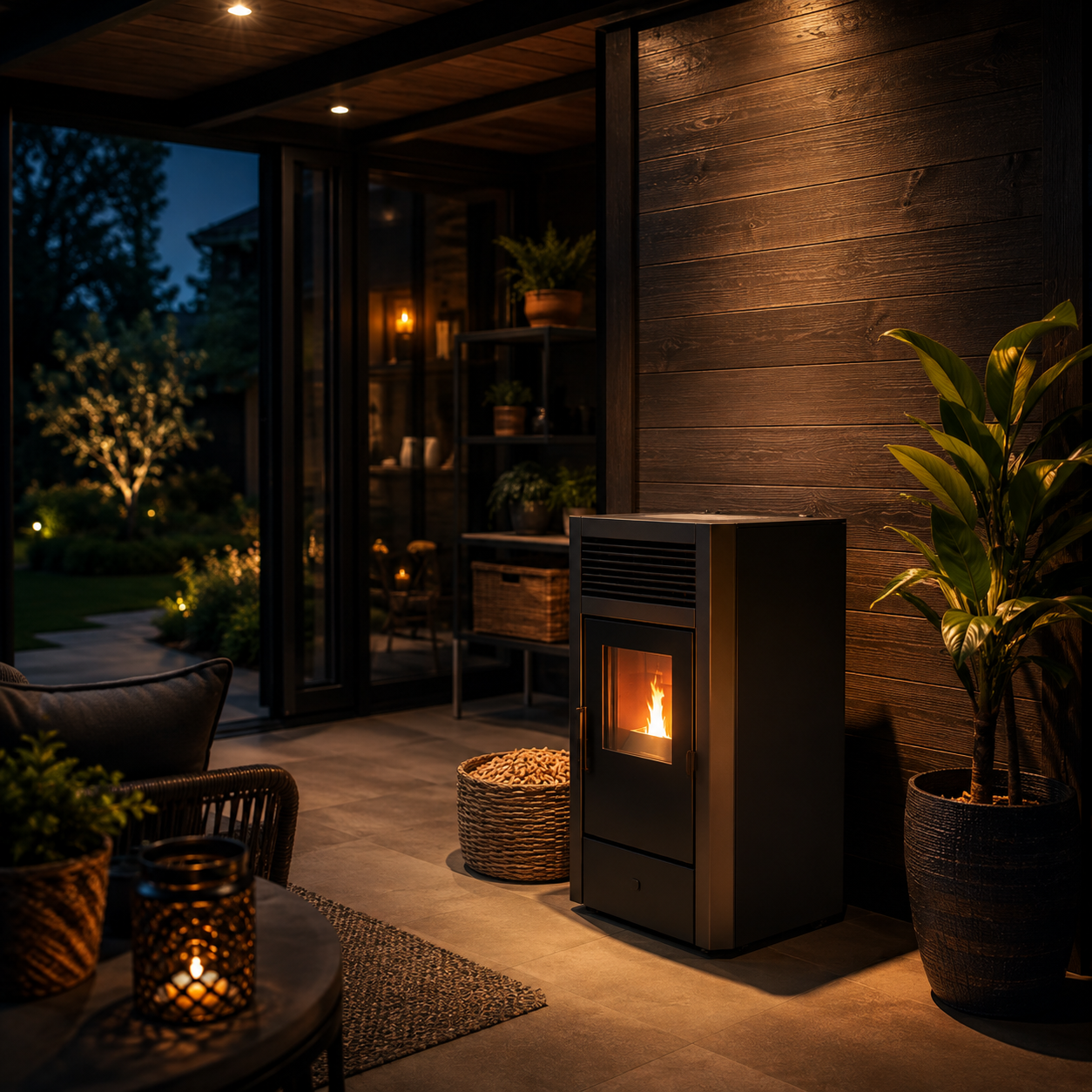
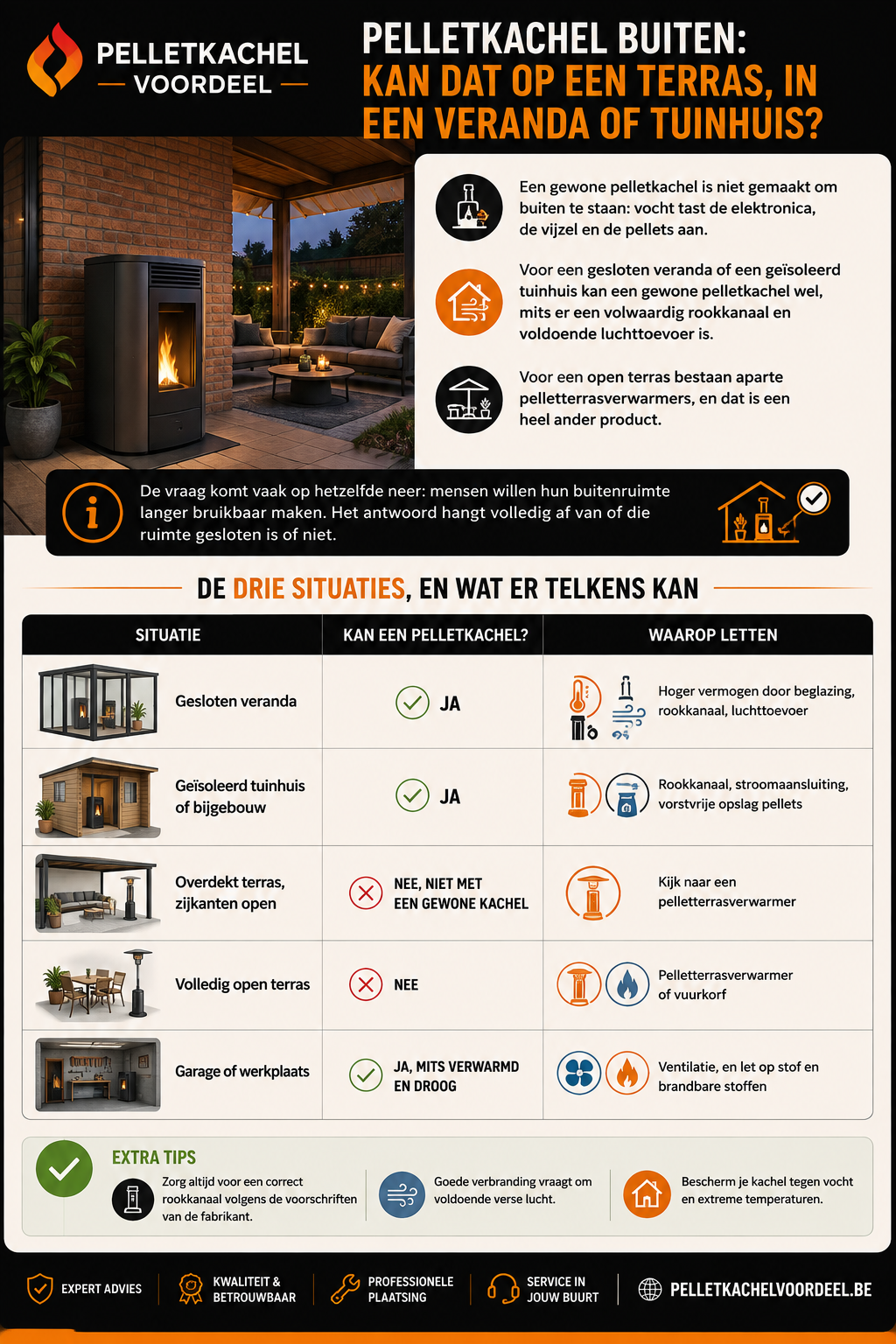
Can you put a standard pellet stove outside? This one is not at all designed to be left outside: Moisture damages the electronics, the auger and the pellets. For an enclosed conservatory or an insulated garden shed, a standard pellet stove is suitable, provided there is a proper flue and an adequate air supply. For an open terrace, there are separate pellet patio heaters available, which are a completely different product.
The question often boils down to the same thing: people want to be able to use their outdoor space for longer. The answer depends entirely on whether that space is enclosed or not.
The three situations, and what can be done in each case
| Situation | Can a pellet stove? | What to look out for |
|---|---|---|
| Enclosed veranda | Yes | Higher power output thanks to the glazing, flue, air supply |
| Insulated garden shed or outbuilding | Yes | Flue, mains power connection, frost-free pellet storage |
| Covered terrace, open at the sides | No, not with an ordinary stove | Take a look at a pellet patio heater |
| Fully open terrace | No | Pellet patio heater or fire pit |
| Garage or workshop | Yes, provided it is warm and dry | Ventilation, and be mindful of dust and flammable substances |
Why a standard heater can’t be used outdoors
It’s not about the heat, but about damp and air.
- Electronics. The circuit board, display and wiring are not weatherproof. Condensation alone is enough to cause problems after one or two seasons.
- The pellets in the tank. The tank is not airtight. Pellets that absorb moisture swell up and block the screw conveyor.
- Corrosion. The housing and the screw are not designed for outdoor use.
- The combustion process itself. A pellet stove operates using a precisely regulated air flow. Wind around an open installation disrupts this, resulting in inconsistent combustion and error messages.
Veranda: the power is greater than you think
A veranda is the most common scenario, and the most common mistake is to underestimate the power required.
Glass insulates much less effectively than a wall. Whilst you would expect a standard room to have a heat loss of 0.08 kW per cubic metre, for a conservatory with double glazing you would expect it to be between 0.12 and 0.15, and even higher with single glazing.
| Veranda | Double glazing | HR glazing |
|---|---|---|
| 15 m² | 5 to 6 kW | 4 kW |
| 20 m² | 6 to 8 kW | 5 kW |
| 25 m² | 8 to 9 kW | 6 kW |
| 30 m² | 9 to 11 kW | 7 kW |
Other important considerations when building a veranda:
- The flue. Drilling a hole in a glass roof requires a specialised roof penetration with the correct waterproofing. That’s a job for a professional, and it’s the most expensive part of the project.
- Air supply. A modern conservatory is often quite airtight. In such cases, an external air supply is recommended or even compulsory.
- Free distances. Different minimum distances apply to glass than to a wall. Please refer to the manufacturer’s installation diagram.
- The floor. A floor slab is usually required where the sub-base is combustible.
Garden shed or outbuilding
Technically, this is the same as a standard room, with three additional points to bear in mind:
- Electricity. There must be a proper connection; no extension lead from the house.
- Flue passing through a timber structure. This requires a certified roof penetration with sufficient clearance from combustible materials. People often cut corners here, and that is precisely where they mustn’t.
- Pellet storage. Do not store the pellets in the garden shed itself unless it is really dry. Most garden sheds are not.
If you’re only going to heat the garden shed occasionally, choose a heater with a low minimum output that heats up quickly, and bear in mind that the building will need to lose its chill first.
Pellet patio heaters: a different product
There are specialised units available for open or semi-open terraces: freestanding pellet burners that give off heat through radiation, rather than via a fan. Features:
- They often operate without electricity, using natural draughts
- They provide heat through radiation, so you feel the heat directly rather than the heat in the room
- They don’t need a flue, as they’re installed outdoors
- The range is limited to a few metres around the device
So this isn’t about heating a room, but heating people – much like a patio heater or a fire pit. Don’t expect it to provide the same level of comfort as your living room.
What you’ll need, whatever happens
For any enclosed space, whether it’s a conservatory, a garden shed or a garage:
- A fully-fledged flue with the correct diameter and height, correctly routed through the roof or wall
- A calculation of the tensile force, because a channel that is too short results in poor combustion and error messages
- Sufficient combustion air, preferably supplied externally
- Proper floor protection on a flammable surface
- A power socket in a reputable circle
Have the flue calculation and installation carried out by a certified installer. In the case of an outdoor installation or a glass roof, this is not merely a formality but the crux of the job. Pellet Stove Care carries out that sort of calculation and positioning.
View the full range of pellet stoves or, if space is limited, the narrow pellet stoves.
Frequently Asked Questions
Can a pellet stove be placed outside?
A standard pellet stove is not suitable. Moisture damages the electronics, the auger and the pellets, and wind disrupts the combustion process. For outdoor use, there are specialised pellet patio heaters that operate on radiant heat.
Can I install a pellet stove in my conservatory?
Yes, that’s possible in an enclosed conservatory. Do bear in mind, however, that you’ll need a higher power rating than for a normal room – around 0.12 to 0.15 kW per cubic metre – because glass is a much poorer insulator. The roof penetration through a glass roof is the most expensive and technically complex part of the installation.
Can a pellet stove be installed in a garden shed?
Yes, provided there is a suitable power connection and the flue is correctly routed through the timber structure using a certified flue sleeve. It is best not to store the pellets in the garden shed itself.
What power rating is required for a 20 m² veranda?
For double glazing, around 6 to 8 kW; for high-efficiency glazing, around 5 kW. That is significantly more than for a standard room of the same size.
What is a pellet patio heater?
A freestanding appliance that burns pellets and emits heat by radiation rather than via a fan. It often operates without electricity and does not require a flue, but it only heats the immediate surroundings and not the entire room.
Do I need a planning permission for a pellet stove in an outbuilding?
This is not usually the case for the appliance itself, but local planning regulations apply to a new flue passing through the roof or façade. Check with your local council before you start, particularly if it’s a detached outbuilding.